With the advent of Technology and AI, the role of technology in event management is becoming crucial day by-day, today, we are going to provide light on one of such technologies, RFID. Radio Frequency Identification or RFID event technology uses small wireless tags embedded in badges, wristbands, or cards to enable fast, contactless interactions at events.
- What Is RFID Event Technology?
- Key Benefits of RFID Event Technology
- Core Applications & Use Cases of RFID Technology in Events
- RFID Event Technology Implementation Strategy
- RFID Event technology Challenges & Solutions
- RFID Event Technology – Implementation Tips
- RFID Event Technology – Case Studies
- FAQs
- How does RFID improve event security?
- What kinds of events benefit most from RFID technology?
- What’s the difference between RFID and traditional barcode scanning?
- Can RFID provide useful data beyond tracking entry?
- Can RFID integrate with my current event software?
- What influences RFID costs?
- How does RFID improve safety at events?
- Conclusion – RFID’s Transformational Role in Event Tech
Unlike barcodes, RFID doesn’t need direct line-of-sight to be read, allowing attendees to breeze through entry points, make cashless payments, and move freely while organizers collect real-time data on crowd movement and engagement. This seamless and efficient system enhances security, improves attendee experience, and provides event profs with valuable insights for smarter event management.
What Is RFID Event Technology?
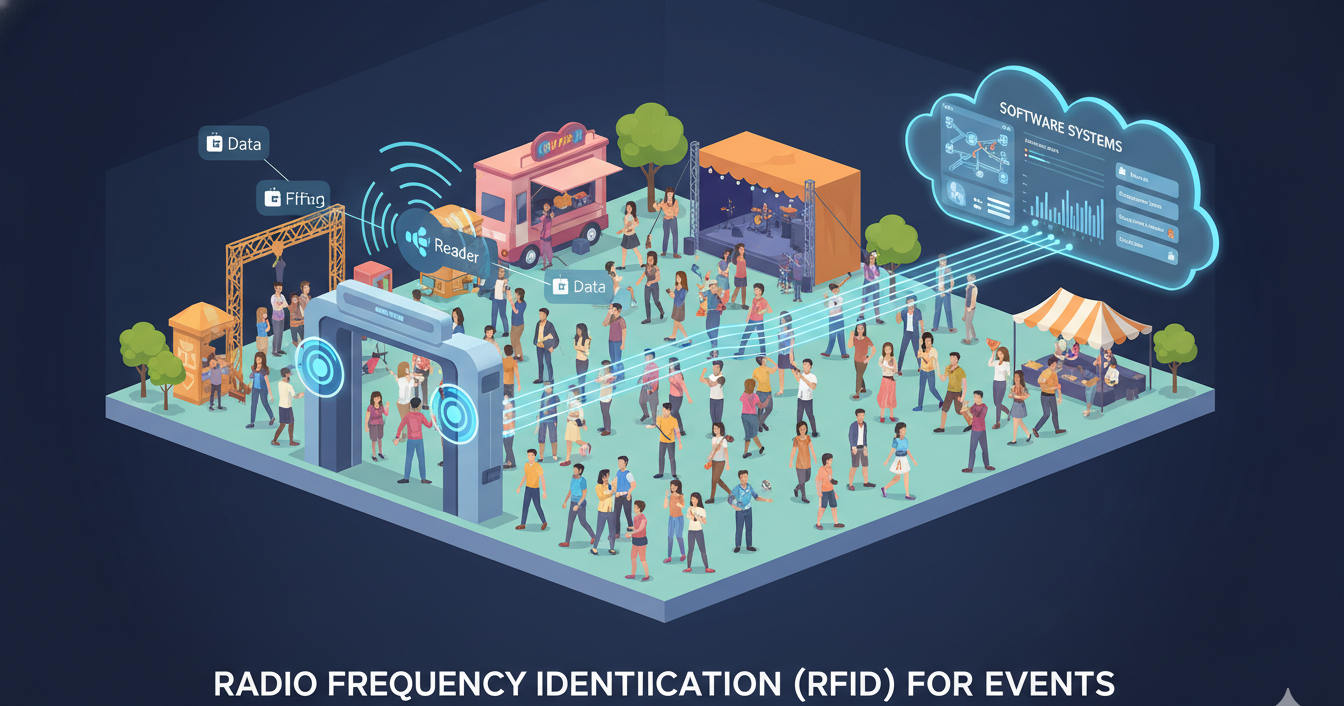
How RFID Works in Events
RFID stands for Radio Frequency Identification, a wireless communication system that uses radio waves to automatically identify and track tags attached to objects — or in this case, people at events. RFID systems consist of:
- RFID Tags: Tiny chips with antennas that store data.
- RFID Readers: Devices that communicate with tags and read their data.
- Software Systems: Event platforms that capture and analyze the data collected by readers.
Because RFID tags can be read without direct scanning, multiple tags can be registered quickly as attendees pass through checkpoints or engage with systems on the event floor.
Passive vs. Active RFID Tags
- Passive RFID Tags: Don’t have a battery and activate only when in range of a reader. These are common for wristbands and badges used at event entry points.
- Active RFID Tags: Battery-powered and can transmit data over longer distances, often used for tracking assets or equipment within large venues.
Key Benefits of RFID Event Technology
Faster Access and Reduced Queues
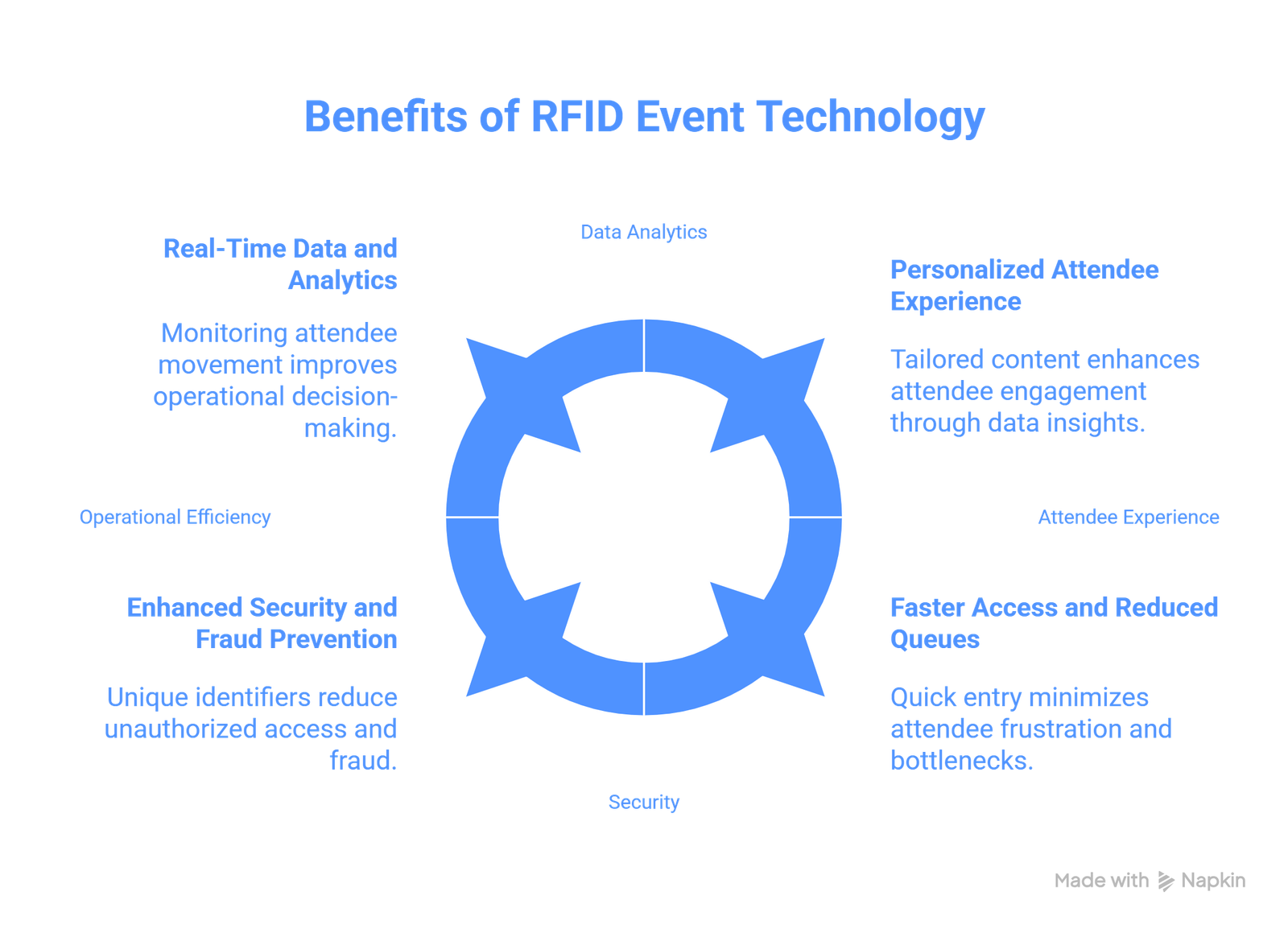
Traditional ticket scanning often means long lines and frustrated attendees. RFID technology eliminates the need for physical scanning: attendees simply walk past an RFID reader, and the system automatically logs their entry. This speeds up check-in and reduces bottlenecks at busy entrances.
Enhanced Security and Fraud Prevention
Each RFID tag carries a unique identifier that can’t be easily duplicated, which significantly reduces ticket fraud and unauthorized access. RFID systems also help ensure that only valid attendees enter restricted areas, boosting overall event security.
Real-Time Data and Analytics
One of the strongest advantages of RFID event technology is its ability to collect real-time attendee movement and behavior data. Organizers can monitor session attendance, queue lengths, and foot traffic patterns across zones. This not only improves operational decision-making during events but also enhances post-event analysis and planning.
Cashless Payments and Revenue Boost
Many events integrate RFID with cashless payment systems. Attendees load funds onto their RFID wristbands or badges and make purchases with a simple tap. This accelerates transactions and boosts vendor sales, while organizers gain insights into spending habits and revenue trends.
Personalized Attendee Experience
By linking attendee profiles with RFID interactions, organizers can create personalized experiences — from tailored content recommendations to bespoke offers at select booths or areas.
Core Applications & Use Cases of RFID Technology in Events
Access Control and Entry Management
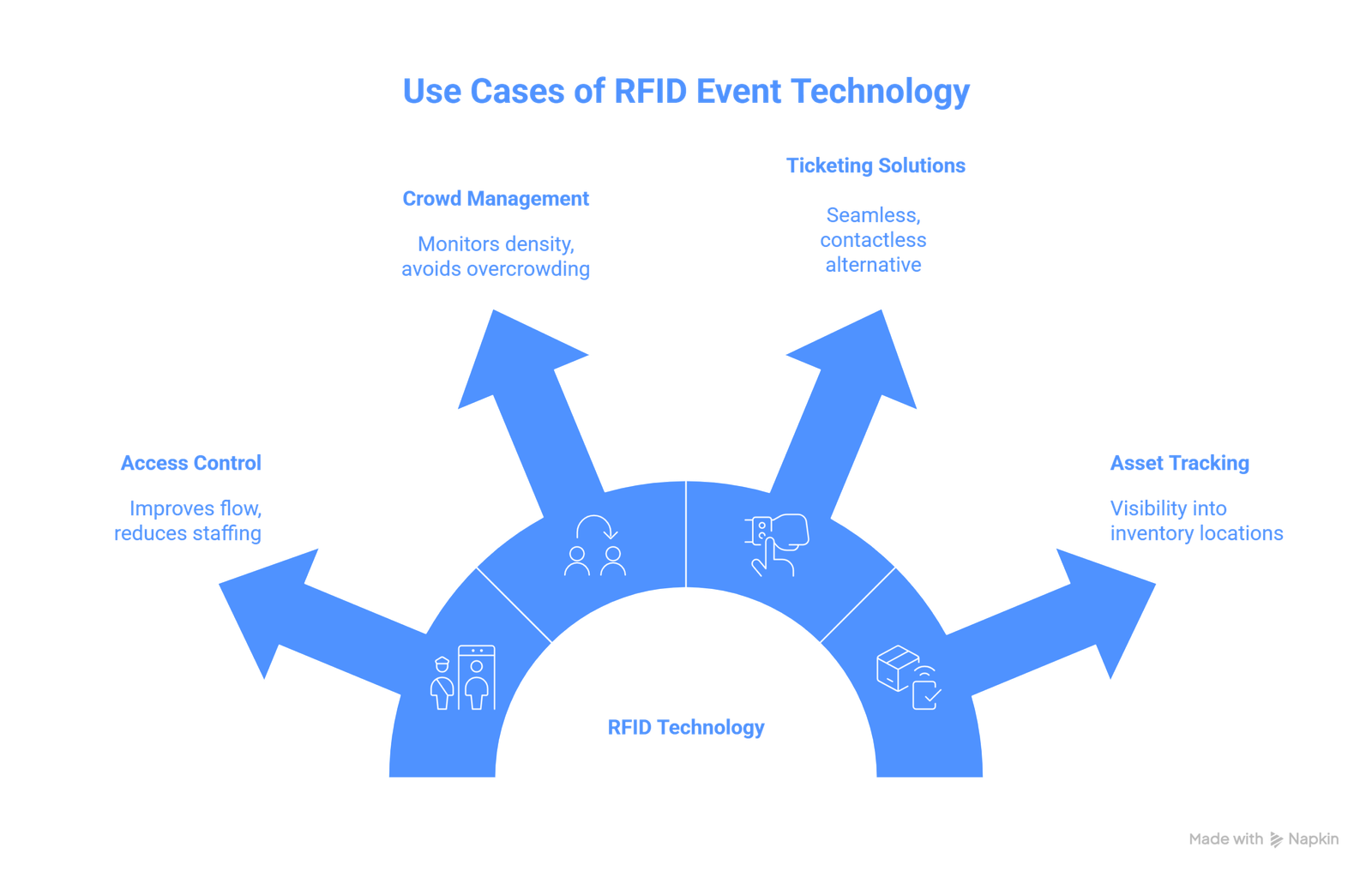
RFID revolutionizes access control by enabling instant verification at gates and doors. Attendees simply present their RFID wristband or badge, and the event system confirms entry in milliseconds. This improves flow and reduces staffing needs at entrances.
Crowd and Crowd Flow Management
With RFID readers placed strategically, organizers can monitor crowd density and movement in real time. This is crucial for safety and for allocating staff or redirecting traffic to avoid overcrowding.
Ticketing and Check-In Solutions
RFID replaces traditional check-in methods — like paper tickets or QR codes — with a seamless, contactless alternative that improves throughput and minimizes waiting.
Asset and Equipment Tracking
Beyond people tracking, RFID tags can be attached to assets like AV equipment, signage, or rental gear. This provides visibility into inventory locations throughout the event area.
Event Types That Benefit Most by Using RFID Event Technology
RFID event technology is particularly impactful at:
- Music festivals and concerts
- Trade shows and expos
- Conferences and corporate events
- Sporting events and large public gatherings
RFID Event Technology Implementation Strategy
Implementing RFID event technology can be transformative, but it needs thoughtful planning and strategic execution to deliver value. Whether your goal is smoother check-ins, real-time analytics, or cashless payments, here’s how to implement RFID successfully for events.
Plan Your RFID Deployment Step-by-Step
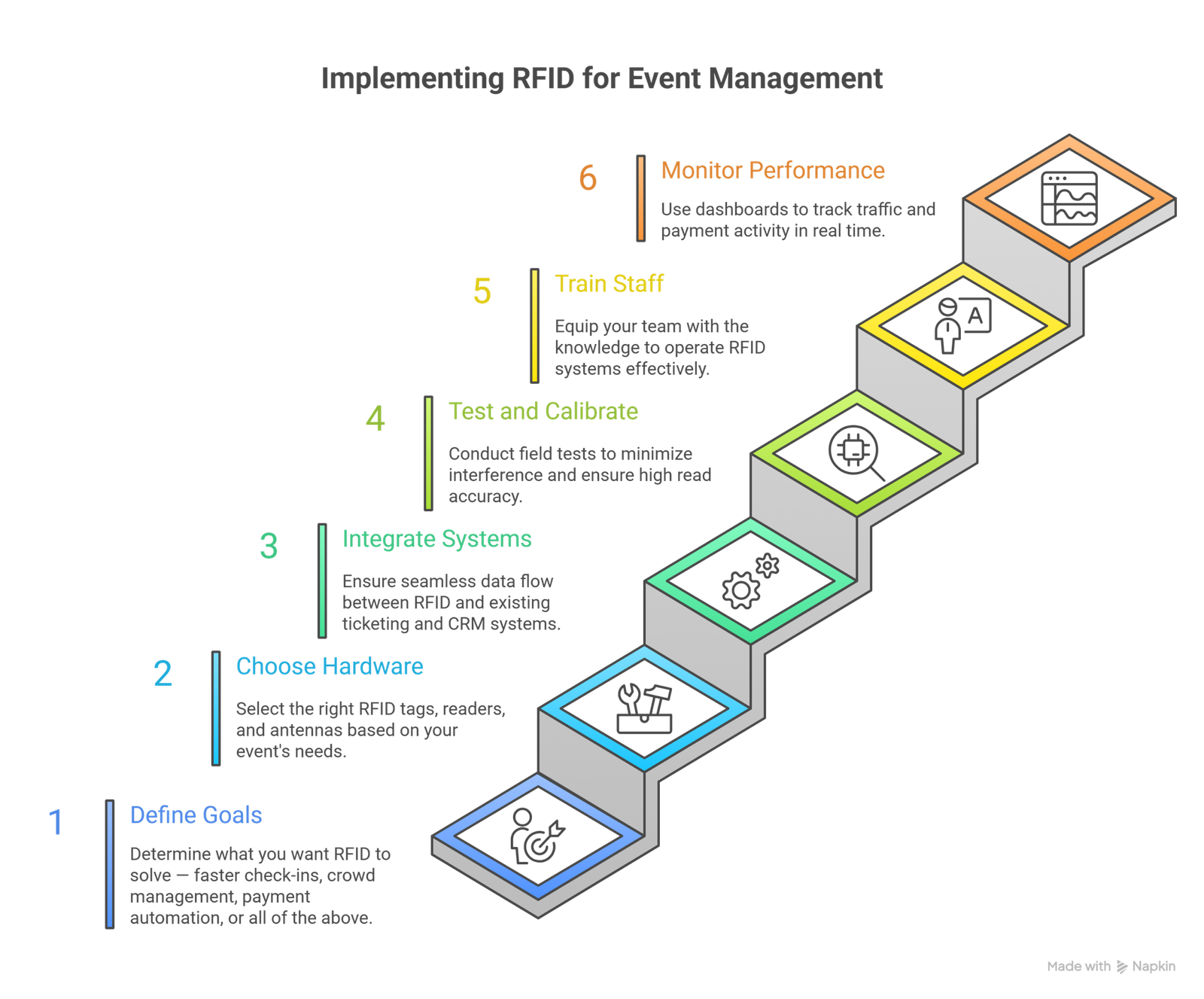
- Define your goals:
Determine what you want RFID to solve — faster check-ins, crowd management, payment automation, or all of the above. Clear goals shape hardware, software, and placement decisions. - Choose the right hardware:
- RFID tags (wristbands, badges) — match type (HF/UHF) to use case.
- Readers & antennas — place them at strategic points like entrance gates, session halls, payment zones, and VIP areas.
- Integration software — ensure your event platform supports RFID data capture, analytics, and dashboarding.
- Integrate with existing systems:
Modern RFID solutions offer APIs for ticketing platforms and CRM systems, allowing seamless data flow between registration, attendee management, and engagement tools. - Test and calibrate:
Field test with sample attendee flows before event start. Calibrate readers to minimize interference and ensure high read accuracy. - Train your staff:
RFID can streamline operations, but staff should understand reader placement, troubleshooting, and customer support around RFID wristbands and access points. - Monitor performance in real time:
During the event, dashboards should show traffic hotspots, entrance congestion, and payment activity so you can respond instantly.
Tip: Many organizers start with one core use case (e.g., entry tracking) and scale to full access control and analytics once initial value is demonstrated.
RFID Event technology Challenges & Solutions
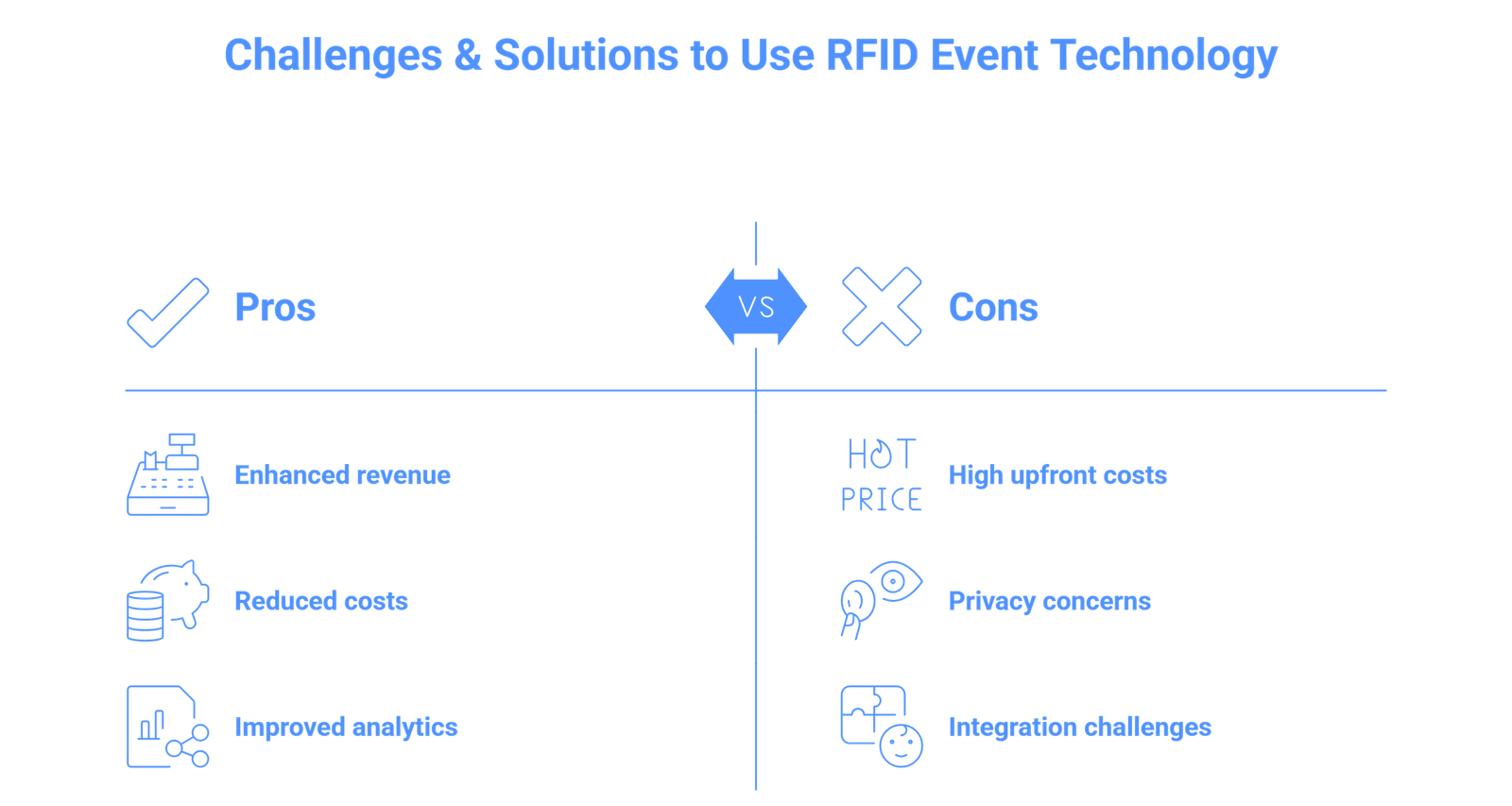
While RFID delivers major benefits, event teams should anticipate and plan for common hurdles:
Cost Considerations
RFID deployment isn’t “turnkey cheap.” Costs depend on:
- Event size
- Number and type of readers
- RFID tags and middleware
- Integration and support services
Although most organizers see ROI through enhanced revenue and reduced operational cost, upfront planning and budgeting are critical when justifying the investment.
Best practice: Run a cost-benefit analysis comparing traditional approaches with RFID—considering reduced labor, increased revenue from cashless spending, and improved analytics.
Privacy & Security Concerns
RFID tags broadcast unique identifiers, which could theoretically be read or tracked beyond intended areas without safeguards.
Mitigation strategies:
✔️ Use cryptography or rolling identifiers
✔️ Limit read range where practical
✔️ Clearly communicate data usage and privacy policies to attendees
Ensuring attendees understand what data is captured and why improves trust and compliance.
Integration & Technical Compatibility
Seamless integration with ticketing, CRM, and payment platforms is essential. Lack of integration can limit RFID value by siloing data or creating manual reconciliation work.
Best practice: Choose RFID platforms with flexible APIs and vendor support for your tech stack.
RFID Event Technology – Implementation Tips
- Start with clear goals for RFID use
- Choose appropriate hardware and scalable software
- Integrate deeply with your event ecosystem
- Test & train before go-live
- Address privacy with robust policies
- Treat RFID data as insight, not just attendance logs
RFID Event Technology – Case Studies
RFID technology isn’t just theoretical — it has been successfully deployed at major events worldwide to enhance operations, attendee experience, security, and revenue. These case studies demonstrate how RFID systems work in practice and why they’re becoming essential for modern event teams.
RFID in Action: Osheaga Festival (Canada)
At the popular Osheaga Music & Arts Festival, RFID wristbands were integrated into the attendee experience to offer more than just entry management. Once registered and linked, attendees could upload sponsor-branded photos from photo kiosks around the festival, extending engagement and enhancing brand visibility. This integration demonstrates how RFID not only boosts efficiency but adds interactive value across the event.
Beamian RFID Deployment Success
In corporate and internal event settings, Beamian’s RFID solutions have improved efficiency and security. For example, events using RFID cards benefited from access control systems that protected personal data (storing only unique RFID identifiers) while providing robust event management functionality — from access to consumption tracking to certificate issuance — streamlining staff workflows and attendee touchpoints.
Cashless RFID at Big Festivals
Major music festivals and cultural events have widely adopted RFID wristbands not just for access control but as cashless payment devices, dramatically simplifying transactions and reducing queues at food, drink, and merchandise stalls. This results in higher average per-attendee spend and a smoother, more frictionless visitor experience.
Crowd Management & Safety Use Cases
RFID systems support safer crowd movements by tracking attendee positioning in real time and identifying bottlenecks before they become hazards — essential for large-scale gatherings. Charged with monitoring capacity limits and real-time movement, RFID-driven analytics help organizers preemptively address overcrowding and improve overall event flow.
FAQs
How does RFID improve event security?
RFID wristbands and badges use encrypted unique identifiers that are extremely difficult to duplicate, helping to prevent ticket fraud and unauthorized access. These systems also allow tiered access control — for example, restricting backstage or VIP zones — and provide real-time visibility into crowd flows for safety teams.
What kinds of events benefit most from RFID technology?
From music festivals and trade shows to corporate conferences and sporting events, RFID adapts to many event types. Its utility scales from simple entry tracking to complex crowd analytics and cashless ecosystems, making it valuable for any event with high attendance or multiple operational needs.
What’s the difference between RFID and traditional barcode scanning?
Unlike barcodes, which require line-of-sight scanning, RFID tags can be read automatically within range of a reader without manual scanning. This greatly increases speed and throughput during entry, purchase, or check-in processes.
Can RFID provide useful data beyond tracking entry?
Yes — every interaction or tap can feed analytics systems, enabling organizers to see time of entry, session popularity, booth visibility, and purchase behaviors, which helps plan better future events and create targeted marketing strategies.
Can RFID integrate with my current event software?
Yes. Many RFID solutions support integration via APIs with existing ticketing or CRM platforms, enabling unified attendee profiles and real-time data usage.
What influences RFID costs?
Costs vary with tag type, number of readers, software complexity, and event scale. While initial costs may seem higher than simpler systems, RFID often pays off through increased efficiency and revenue generation.
How does RFID improve safety at events?
RFID event technology enhances safety by tracking real-time attendee movement and crowd density, enabling rapid response during emergencies and better compliance with capacity limits.
Conclusion – RFID’s Transformational Role in Event Tech
RFID event technology has evolved from a niche access control tool into a central operational platform that empowers organizers with seamless entry, secure environments, real-time analytics, and immersive attendee experiences. From reducing queue times to enabling cashless systems and real-time crowd insights, RFID adds measurable value at every stage of the event lifecycle.
As events grow in scale and sophistication, the technology’s ability to integrate data, enhance safety, and deliver smooth, modern experiences will continue to make RFID a must-have solution for forward-thinking planners.
Ready to elevate your next event with RFID event technology?
Explore tailored RFID systems that speed up check-ins, secure your venue, increase revenue, and unlock real insights — start with a personalized demo or expert consultation today! 🚀