

Managing school events involves much more than selecting a date and sending invitations. Whether it’s an annual function, sports day, parent-teacher conference, admission open house, fundraiser, or cultural festival, schools often juggle registrations, communications, permissions, attendance tracking, and post-event analytics reporting simultaneously.
School event management software brings all these activities together in one centralized platform. Instead of relying on spreadsheets, email chains, paper forms, and manual coordination, schools can automate event planning, streamline communication, improve attendance, and gain valuable insights from every event.
In this guide, you’ll learn what school event management software is, how it works, the key features to look for, and how it can help schools create better event experiences for students, parents, teachers, and administrators.
What is a School Event Management Software?

Role of technology in event management is becoming cruscial day by day. School event management software is a digital platform designed to help educational institutions plan, organize, promote, and manage events efficiently. It automates repetitive administrative tasks while providing a seamless experience for attendees and organizers alike.
From small classroom activities to large-scale annual events, the software serves as a central hub where schools can coordinate every stage of event management.
Definition and Core Purpose
At its core, school event management software helps schools:
- Create and publish events
- Manage registrations and RSVPs
- Collect payments when required
- Send event notifications and reminders
- Track attendance
- Generate event reports
- Coordinate multiple stakeholders
Rather than using separate tools for communication, registration, calendars, and reporting, schools can manage everything from a single platform.
How It Differs From General Event Management Software
While traditional event management platforms are built for businesses, conferences, and corporate events, school-focused solutions address the unique needs of educational institutions.
These include:
- Parent and guardian communication
- Student-specific registration workflows
- Permission slip management
- Classroom and grade-level segmentation
- School calendar integration
- Multi-campus administration
- Staff approval workflows
The result is a solution tailored specifically for education environments.
Who Uses School Event Management Software?
Various stakeholders benefit from the platform:
School Administrators
Administrators use it to oversee event planning, monitor participation, and ensure smooth execution.
Teachers
Teachers can manage class-specific activities, track attendance, and communicate event details with parents.
Admissions Teams
Open houses, campus tours, and enrollment events become easier to coordinate and measure.
Parent Associations
PTAs and PTOs can organize fundraisers, volunteer programs, and community events with minimal administrative effort.
Marketing Teams
Schools increasingly use events to strengthen their brand and community engagement. Event software helps measure campaign effectiveness and attendance performance.
Why Schools Need Event Management Software
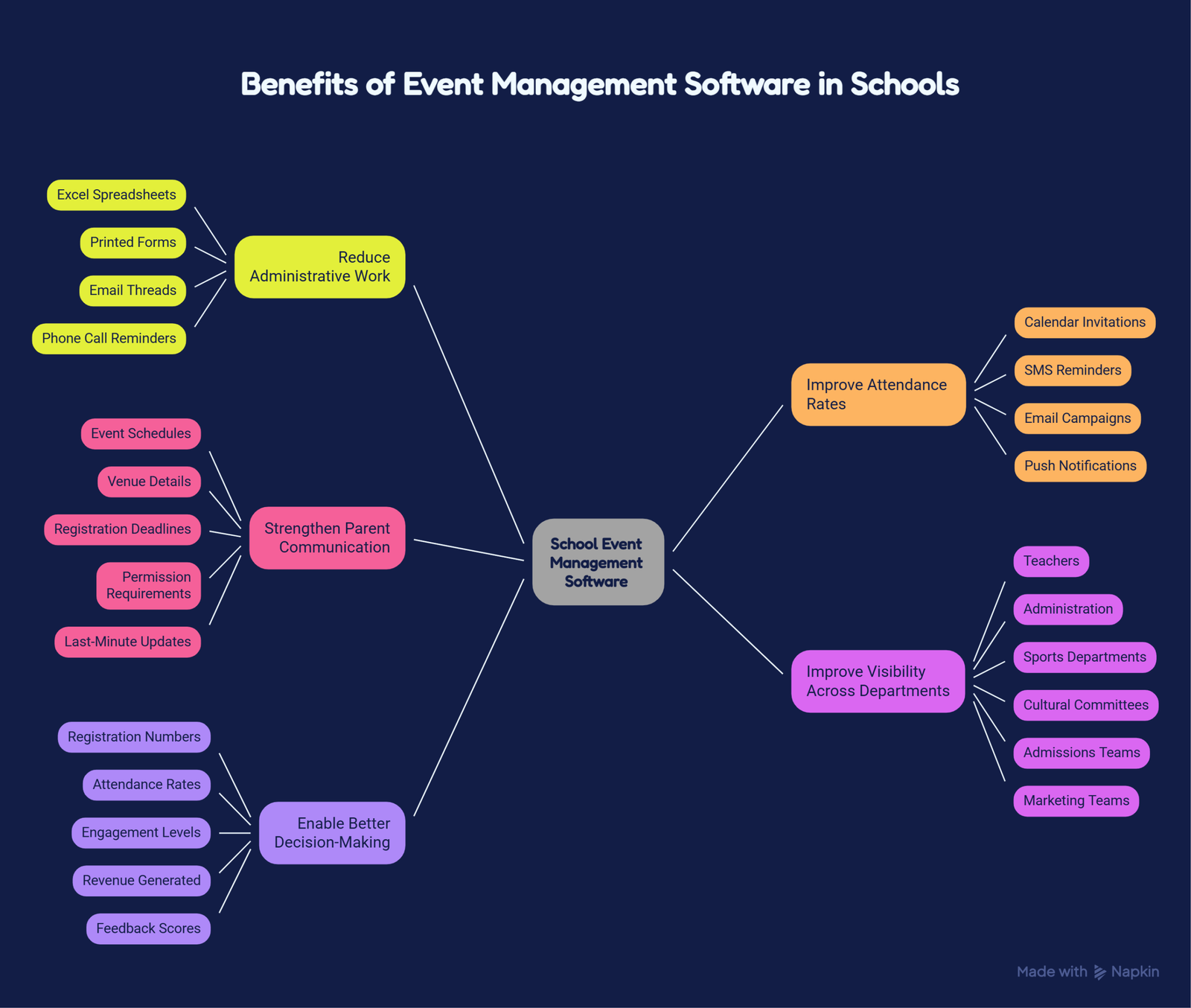
Schools conduct dozens, sometimes hundreds of events every year. Without a structured system, administrative overhead can quickly become overwhelming.
Reduce Administrative Work
Many schools still rely on manual processes such as:
- Excel spreadsheets
- Printed forms
- Email threads
- Phone call reminders
These methods are outdated, time-consuming and prone to errors.
Event management software automates routine tasks, allowing staff to focus on creating meaningful experiences rather than handling logistics.
Improve Attendance Rates
One of the biggest challenges schools face is low event participation.
Automated reminders significantly improve attendance by ensuring that parents, students, and staff receive timely notifications.
Features like:
- Calendar invitations
- SMS reminders
- Email campaigns
- Push notifications
help keep attendees informed and engaged.
Strengthen Parent Communication
Parents often miss important event details because communication is scattered across multiple channels.
A centralized school event platform ensures that information such as:
- Event schedules
- Venue details
- Registration deadlines
- Permission requirements
- Last-minute updates
is easily accessible from one location.
Improve Visibility Across Departments
School events often require coordination between:
- Teachers
- Administration
- Sports departments
- Cultural committees
- Admissions teams
- Marketing teams
Event management software creates a single source of truth that improves collaboration and reduces confusion.
Enable Better Decision-Making
Without data, it’s difficult to understand which events perform well.
Modern platforms provide reporting dashboards that reveal:
- Registration numbers
- Attendance rates
- Engagement levels
- Revenue generated
- Feedback scores
This allows schools to continuously improve future events.
Key Features to Look For in School Event Management Software
Not all solutions are created equal. The best platforms provide features that simplify planning while improving participant experience.
Event Creation and Scheduling
Schools should be able to create events within minutes using customizable templates.
Important capabilities include:
- Recurring events
- Multi-day scheduling
- Location management
- Resource allocation
- Event categorization
Online Registration and RSVP Management
Registration should be simple for parents and students.
Look for features such as:
- Custom registration forms
- Multiple attendee types
- Waitlists
- Capacity limits
- Registration approvals
A smooth registration experience often leads to higher attendance rates.
Payment Collection and Ticketing
Many school events involve fees.
Examples include:
- Fundraisers
- Summer camps
- Workshops
- Alumni gatherings
- Sports tournaments
Integrated payment processing eliminates manual collection and reconciliation.
Automated Communication
Communication automation is one of the biggest time-saving features.
The best systems allow schools to send:
- Confirmation emails
- Reminder notifications
- Event updates
- Follow-up surveys
- Thank-you messages
Automation ensures consistency while reducing staff workload.
Permission Slip Management
For educational institutions, permission slips remain an important part of event planning.
Digital permission management can:
- Collect electronic signatures
- Store approvals securely
- Reduce paperwork
- Improve compliance
Attendance Tracking
Attendance data helps schools measure event success.
Popular methods include:
- QR code check-in
- Mobile attendance tracking
- Digital badge scanning
- Manual check-in systems
Real-time attendance visibility is particularly useful for large-scale events.
Reporting and Analytics
Analytics help schools understand event performance.
Useful metrics include:
- Registration trends
- Attendance rates
- Engagement levels
- Revenue reporting
- Event satisfaction scores
Data-driven insights support better planning and resource allocation.
Calendar and System Integrations
The best event management software integrates with:
- School calendars
- Email platforms
- CRM systems
- Student information systems
- Marketing automation tools
Integrations eliminate duplicate work and improve operational efficiency.
How School Event Management Software Works
Understanding the workflow helps schools evaluate potential solutions more effectively.
Step 1: Create the Event
Administrators create an event and define:
- Date
- Venue
- Capacity
- Registration requirements
- Event details
Templates can significantly speed up setup.
Step 2: Publish Registration Pages
The platform generates a registration page where attendees can:
- Register online
- Select participation options
- Submit required information
- Complete payments if necessary
Step 3: Promote the Event
Schools promote events through:
- Email campaigns
- School websites
- Mobile apps
- Social media channels
- Parent portals
A centralized promotion strategy increases visibility.
Step 4: Manage Attendees
Organizers can monitor:
- Registration numbers
- Waiting lists
- Attendance forecasts
- Volunteer assignments
All information remains accessible from a single dashboard.
Step 5: Track Attendance
On event day, schools can check attendees in using digital tools and monitor participation in real time.
Step 6: Analyze Results
After the event, reporting dashboards provide insights that help improve future planning.
Top Benefits of School Event Management Software
Schools are expected to deliver engaging events while managing limited administrative resources. Event management software helps institutions streamline operations, improve communication, and create better experiences for students, parents, and staff.
Better Event Participation
One of the biggest challenges schools face is encouraging attendance. Parents are busy, students forget deadlines, and important announcements can get lost in crowded inboxes.
Event management software increases participation by providing:
- Automated reminders
- Mobile-friendly registration
- Calendar integration
- Real-time updates
- Simplified RSVP processes
When attendees have easy access to event information, participation rates naturally improve.
Reduced Administrative Burden
Traditional event planning often involves:
- Printing forms
- Sending emails manually
- Tracking responses in spreadsheets
- Following up individually
These repetitive tasks consume valuable staff time.
By automating registrations, communications, approvals, and reporting, schools can significantly reduce administrative workload and focus on delivering successful events.
Improved Communication
Miscommunication is one of the most common causes of event-related issues.
School event management software creates a centralized communication hub where organizers can share:
- Event updates
- Schedule changes
- Venue details
- Emergency announcements
- Follow-up information
This ensures everyone receives consistent and accurate information.
Stronger Parent Engagement
Parents are more likely to participate when information is accessible and easy to act upon.
Features such as:
- Mobile registration
- Automated reminders
- Event notifications
- Digital permission slips
make it easier for parents to stay involved in school activities.
Better Reporting and Accountability
School leaders increasingly need data to justify budgets, evaluate programs, and improve future initiatives.
Reporting dashboards provide visibility into:
- Registration trends
- Attendance performance
- Revenue generated
- Volunteer participation
- Event satisfaction
These insights help schools make informed decisions.
Best Use Cases for School Event Management Software
A flexible platform can support a wide range of school activities.
Parent-Teacher Conferences
Managing appointments manually can be difficult for both teachers and parents.
Software solutions help by:
- Allowing online booking
- Preventing scheduling conflicts
- Sending automatic reminders
- Tracking attendance
The result is a more organized and professional experience.
Annual Functions and Cultural Events
Large-scale events involve multiple moving parts.
Schools can use event management software to coordinate:
- Performer schedules
- Volunteer assignments
- Ticket sales
- Guest registrations
- Attendance tracking
Everything is managed from a single dashboard.
Sports Events and Competitions
Sports days often involve hundreds of participants and spectators.
The software can help organize:
- Team registrations
- Match schedules
- Volunteer management
- Participant communications
- Attendance reporting
School Fundraisers
Fundraising events require efficient registration and payment collection.
Features such as:
- Online ticketing
- Donation tracking
- Sponsor management
- Automated receipts
help schools maximize fundraising success.
Open Houses and Admissions Events
Prospective families often form their first impression of a school through admissions events.
Event management software helps schools:
- Capture leads
- Manage registrations
- Send follow-up communications
- Track event performance
This creates a more professional admissions experience.
Alumni Events
Maintaining alumni relationships is increasingly important for schools.
Event platforms make it easier to:
- Manage guest lists
- Promote reunions
- Track attendance
- Collect feedback
School Event Management Software vs Manual Event Planning
Many schools continue to rely on spreadsheets, email chains, and paper-based workflows. While these methods may work for small events, they become increasingly difficult to manage as event complexity grows.
| Feature | Manual Planning | Event Management Software |
|---|---|---|
| Registration Tracking | Time-consuming | Automated |
| Communication | Manual follow-up | Automated reminders |
| Attendance Monitoring | Limited visibility | Real-time tracking |
| Reporting | Manual calculations | Instant dashboards |
| Payment Collection | Difficult to manage | Integrated payments |
| Scalability | Limited | Supports multiple events |
| Data Accuracy | High risk of errors | Centralized and reliable |
The difference becomes especially noticeable when schools manage multiple events throughout the year.
How to Choose the Right School Event Management Software
Selecting the right platform requires careful evaluation.
Identify Your Event Requirements
Start by assessing:
- Number of annual events
- Average attendance
- Registration complexity
- Payment requirements
- Communication needs
The right solution should align with your school’s specific workflows.
Prioritize Ease of Use
If teachers and administrators struggle to use the software, adoption rates will suffer.
Look for:
- Intuitive interfaces
- Minimal training requirements
- Mobile accessibility
- Simple event setup processes
Evaluate Communication Features
Communication is often the most valuable capability.
Ensure the platform supports:
- Email campaigns
- SMS notifications
- Push alerts
- Automated reminders
Review Reporting Capabilities
Strong reporting helps schools continuously improve event performance.
Look for analytics covering:
- Registrations
- Attendance
- Revenue
- Engagement
- Feedback
Check Security and Compliance
Schools handle sensitive student and parent information.
Key security considerations include:
- Data encryption
- Secure authentication
- Role-based permissions
- Compliance with education data regulations
Consider Integration Options
Modern schools use multiple digital systems.
The software should integrate with:
- Student Information Systems (SIS)
- School management software
- CRM platforms
- Email marketing tools
- Calendar applications
Real-World Results: How Schools Benefit
Case Study Example: Increasing Event Attendance
A mid-sized private school struggled with low participation in parent engagement events.
Challenges included:
- Manual invitations
- Missed reminders
- Inconsistent communication
After implementing event management software:
- Registration rates increased significantly
- Reminder automation reduced no-shows
- Administrative workload decreased
Most importantly, parent engagement improved across multiple events.
Case Study Example: Reducing Administrative Time
A school organizing more than 50 events annually relied heavily on spreadsheets and paper forms.
By digitizing registrations, attendance tracking, and communications, the administrative team reduced event coordination time by several hours per event.
This allowed staff to focus on improving event quality rather than handling logistics.
Expert Insights: What Makes School Events Successful?
According to experienced school administrators, successful events share several common characteristics:
Clear Communication
Parents and students need timely information before, during, and after the event.
Simple Registration Processes
Complicated forms discourage participation.
Mobile Accessibility
Most parents access event information through mobile devices.
Automated Reminders
Reminder campaigns consistently improve attendance rates.
Post-Event Analysis
Schools that review attendance, engagement, and feedback data continuously improve future events.
Frequently Asked Questions
What is school event management software?
School event management software is a platform that helps schools organize, promote, manage, and analyze events through features such as registration, communication, attendance tracking, and reporting.
Why do schools need event management software?
Schools use event management software to reduce administrative workload, improve attendance, streamline communication, and gain valuable insights from event data.
Can school event management software manage registrations?
Yes. Most solutions provide online registration forms, RSVP tracking, waitlists, approval workflows, and attendee management features.
Can parents receive automated reminders?
Absolutely. Modern platforms support automated email, SMS, and mobile notifications to keep parents informed about upcoming events.
Is school event management software suitable for large events?
Yes. Most platforms are designed to support everything from classroom activities to large-scale annual functions, sports tournaments, and admissions events.
What features should schools prioritize?
Schools should focus on:
- Registration management
- Automated communication
- Attendance tracking
- Reporting and analytics
- Payment collection
- Security and compliance
How does attendance tracking work?
Attendance can be tracked using QR codes, mobile check-ins, digital badges, or manual verification methods.
Is school event management software secure?
Leading solutions use encryption, secure authentication, role-based permissions, and compliance standards to protect sensitive information.
Conclusion
School events play a critical role in building stronger communities, increasing engagement, and enhancing the overall educational experience. However, managing these events manually can create unnecessary complexity and consume valuable administrative resources.
School event management software helps educational institutions streamline planning, automate communication, improve attendance, and gain actionable insights from every event. Whether you’re organizing parent-teacher conferences, sports days, cultural festivals, fundraisers, or admissions events, the right platform can transform the way your school manages events.
By investing in a solution that centralizes registrations, communications, attendance tracking, and reporting, schools can deliver more successful events while reducing administrative burden.
Ready to Simplify School Event Management?
Stop managing school events through spreadsheets, emails, and paper forms.
Discover how school event management software can help your school plan smarter, communicate better, and increase event participation—all from a single platform.
Book a demo today and see how easy school event management can be.
Leave a Reply